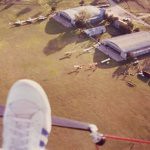
It must be an E model of the C-46. It was the only one made with a stepped windscreen. I think only a few were ever manufactured. Looks kinda goofy, doesn't it?
Yes it was the 'E' variant. I too have pictures of this stepped windscreen version and a bit of 'digging' has turned up this bit of info:
C-46E and C-46F Commando
The beautiful, smooth lines of the C-46's nose were changed to an 'airliner' type of nose on the C-46E (CVV-20E). Only 17 'broken nose' Commandos were built, although a contract for 550 C-46Es was placed (43-47403 through 43-47952). This order was canceled due to the wholesale cutbacks following the end of World War Two in 1945, All C-46Es were delivered during late July and early August of 1945. The 17 C-46Es were in Oakland, California awaiting delivery to the war zone in the Pacific, but were ferried to storage centers in California and Arkansas following the conflict's end. The transports were then turned over to the Reconstruction Finance Corporation (RFC) or the War Assets Administration (WAA) for disposal along with almost 1000 other Commandos worldwide. They were new, and eligible for certification for commercial freight or passenger service by the Civil Aviation Administration CAA) (now known as the Federal Aviation Administration, or FAA). Earl F. Slick of San Antonio. Texas bought all 17 C-46Es for $247,000. Each aircraft cost approximately $25O.O00 when new! He founded Slick Airways in January of 1946. with backing from Texas oil interests who wanted fast service for shipping of pipelines and other related cargo. Slick Airways became the leading airfreight carrier in the United States by the late 1940s. The C-46's higher speed and low ton-per-mile costs compared to ihe Douglas C-47 Skytrains (DC-3s) used by other freight-haulers at the time gave Slick an immediate advantage. (Siick Airways moved From San Antonio to Burbank, California in April of 1959.)
The C-46E's primary distinguishing feature was the stepped nose, with a V-shaped flat panel windshield similar to the C-47. This windshield design and the accompanying deeper side view windows were intended to provide greater visibility. One C-46E (43-46953) with the new windshield configuration was converted as a test vehicle or aerodynamic prototype and was designated the XC-46R. The production version was to be called a C-46E.
To add to my previous post and add to Bridon Bear's information about Slick Airways, the picture below is the database extract from aerotransport.org. I can't provide a link to the source since it os generated on the fly:
Looks like Slick wrecked many of them as well. Always wondered where the name Slick Airways came from.



 I suffer from paranoid amnesia. I can't remember who I don't trust.