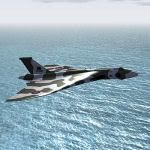
That is very much how most Vulcans ended up looking: i.e a somewhat faded grey colour, and photos of them taken in direct sunlight look very light grey indeed.
But even pictures of early camo Vulcans show the grey looking more like 'light' sea grey (even though it was known as 'medium' sea grey) as on XH558 today.
So, can anyone say why the RAF chose such a hue of grey for the Vulcans AND Victors, which doesn't seem to be very good camouflage. The later wrap-around dark sea grey, as appied to everything else (with dark green) seemed much more appropriate, even though I prefer the lighter colour aesthetically!
Interesting question. Camo has of course evolved, and the grey shade does appear to have darkened over the years, up to the Tornado/Jag etc, but if you look at early Harrier images for example, the shade is much the same. The larger aircraft have more grey on them, over a larger area, and this picks up more light and reflects it back, so in real-life, the same shade of colour will appear different depending on the scale it's applied. It also depends what is underneath the camo - dark or light undercoat? Plain metal? The old white livery?
Also bear in mind that with older images, what you see may not be 100% accurate colour.
I've been pondering whether to buy the Scotflight scenery, as my favourite test route is EGPH - EGPF/vice-versa.
This has convinced me. The Firth of Forth bridges I've seen to date have been rather unconvincing (ditto the Humber Bridge), but that's a fine example in your pic. Scotflight it is!
Regarding the camouflage - my old man used to work in the 4 Sqn RIC in the 70's, and I often got to have a gander at the photographs (in amazing 3D!) taken as well as the various ID mag of the time - don't remember the name - but I was always struck by just how effective these schemes were. Never mind ID the plane - just spotting the thing was the first big hurdle.
I had the same issue in the 80's when I did 6 months with 12 Air Defence Regt (Rapiers) - so any changes made to the hue of grey certainly didn't make a difference in how hard they were to see from above.
Of course, that only applies to stills - it's always the movement that gives them away.